

For this week’s Justice Notes publication, I’m posting a guest essay from Jonathan J. Wroblewski.
In July 2024, Jonathan Wroblewski, a former Department of Justice official and ex-officio member of the U.S Sentencing Commission, along with Professors Doug Berman and Steve Chanenson, started the Sentencing Matters Substack as a new place for commentary and features about sentencing law, policy, and practice. The three of them have been studying, writing, and commenting on sentencing for decades. They teach sentencing courses in different law schools and edit the Federal Sentencing Reporter, a quarterly academic journal that provides a deep dive into sentencing issues and trends, usually organized around a central topic or theme. Berman has written and published the Sentencing Law and Policy blog for over 20 years. It provides daily updates of sentencing news, including court decisions, sentencing commission policymaking and research report releases, relevant federal and state executive branch actions, events around the death penalty, and the work of academics, advocacy groups, and governmental and other non-governmental organizations focused on sentencing and criminal justice more broadly.
Here is an excerpt from an essay that appeared on Sentencing Matters Substack last month commenting on proposed revisions to the federal sentencing guidelines for economic crimes
A Better Economic Crimes Guideline
by Jonathan Wroblewski
The U.S. Sentencing Commission’s proposal to add more culpability factors continues down the rabbit hole of complexity that is incompatible with an effective post-Booker sentencing system
Last August, the U.S. Sentencing Commission announced that one of its priorities for the 2025-26 guideline amendment year was to examine §2B1.1 of the Guidelines Manual, the guideline for fraud and theft crimes. Its goal, it said, was “to ensure the guidelines appropriately reflect the culpability of the individual and the harm to the victim,” and that it would do so by “reassessing the role of actual loss, intended loss, and gain [and] considering whether the loss table in §2B1.1 should be revised to simplify application or to adjust for inflation.” In December, in furtherance of that goal, the Commission published for public comment proposed amendments to §2B1.1. The proposed amendments would, (1) adjust the loss table for inflation, (2) reduce the number of categories of loss from 16 to 8, and (3) add three new culpability factors to the 20 specific offense characteristics and four cross-references to other guidelines already in §2B1.1. The first two proposals seem technical and sensible. The third proposal, adding new culpability factors, is ill-advised.
In 2017, in response to changes made by the Bipartisan Budget Act of 2015, the Commission proposed adding one new culpability factor as a specific offense characteristic to §2B1.1. The Federal Defender Sentencing Guidelines Committee opposed the proposal, calling §2B1.1, as it then existed already, “unwieldy.”
The proposed amendment would add the 20th specific offense characteristic to §2B1.1. It would add unnecessary complexity to a guideline that already covers more than 5 pages, with more than a dozen pages of commentary full of complicated rules for calculating loss and applying the current 19 specific offense characteristics, many with several subparts. Applying this guideline is already difficult and time-consuming and can require lengthy sentencing hearings. The proposed amendment is a paradigm example of “factor creep,” and is not necessary given the range of sentences already provided for in §2B1.1 combined with the adjustments in Chapter Three.
The Defenders were right. Here is the fraud guideline from the original 1987 Guidelines Manual. It fits on one page. It has three specific offense characteristics and no cross-references. A defendant who received every enhancement listed in the guideline would have an offense level of 19. If that defendant had no criminal history and no other applicable aggravating or mitigating guideline factors, the recommended sentence would be between 30 and 37 months in prison.
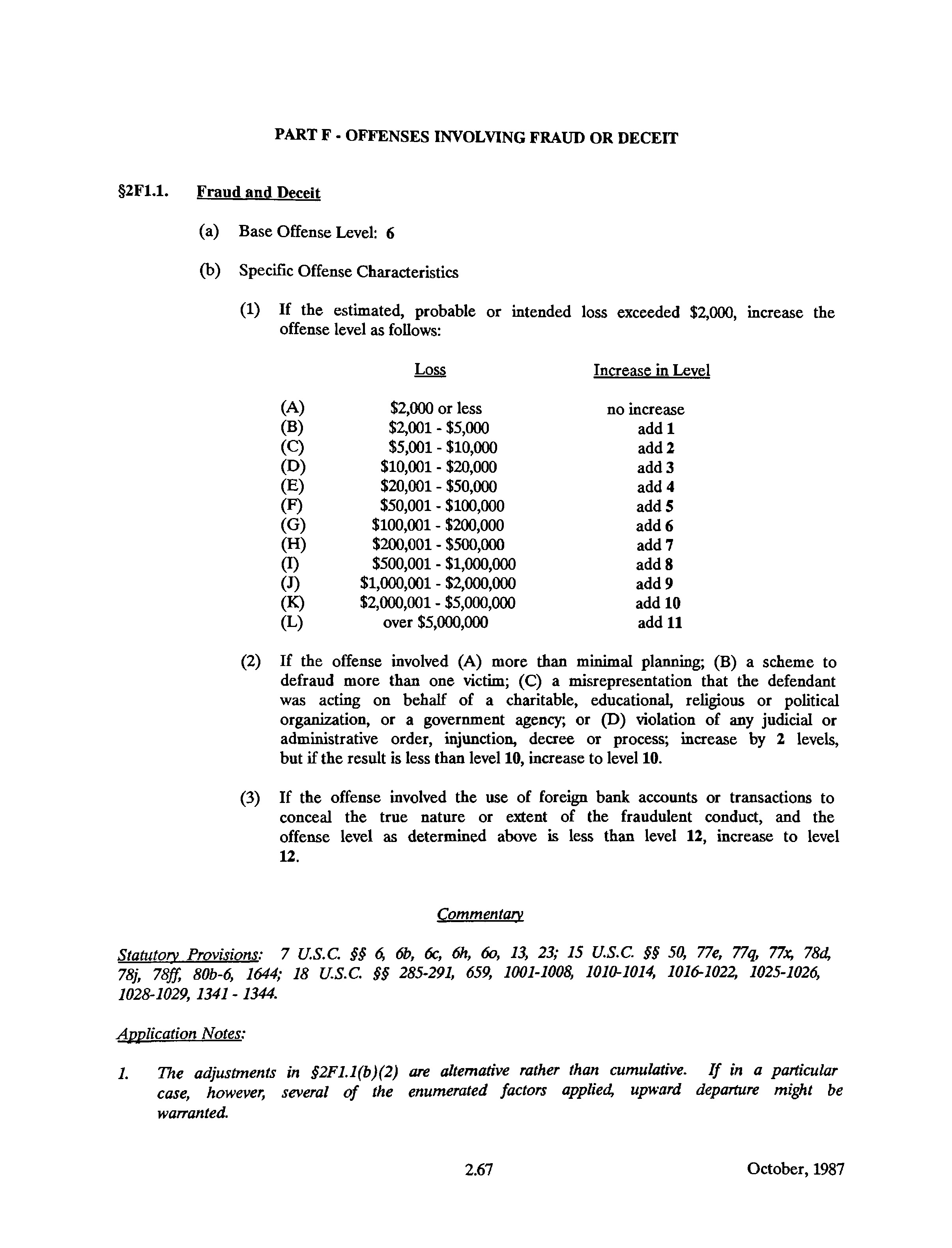
It’s astonishing to compare that guideline to what §2B1.1 is today. The current fraud/theft guideline is set out over six pages. It has 20 specific offense characteristics and four cross-references to other guidelines. A defendant who received every enhancement would have an offense level literally off the charts — Sam Bankman Fried’s offense level was 60 (on a 43-level scale) — and for such a defendant with no criminal history and no other aggravating or mitigating factors, the guideline would recommend a sentence of life in prison without parole. When a guideline produces an offense level off the chart by more than a third, the Commission has lost control of its own algorithm.
Explaining in detail how this evolution occurred would take its own essay, maybe a book. But the short explanation is that current fraud guideline is indeed, as the Federal Defenders indicated in 2017, the manifestation of “factor creep.” It’s a phenomenon the Commission itself discussed in its comprehensive report, Fifteen Years of Guidelines Sentencing, issued in November 2004.
“Detailed rules implementing explicit policies make tinkering with the policies and adding to the rules very easy,” the Commission said. And everyone from members of Congress, the Executive Branch, advocacy organizations, and the Commission itself are drawn to the tinkering. It gives our jobs purpose. I participated many times in advocating on behalf of the Justice Department for a new enhancement here or a new enhancement there. Each of the proposals had a logic to it, and it was difficult to argue that any of the proposed considerations were irrelevant. But as the Commission itself recognized, “as more and more adjustments are added to the sentencing rules, it is increasingly difficult to ensure that the interactions among them, and their cumulative effect, properly track offense seriousness.” Bankman-Fried’s offense level of 60 is proof positive that the Commission itself could not fully understand and control the offense seriousness algorithm of §2B1.1. From the Commission’s 15-year report —
Complex rules with many adjustments may foster a perception of a precise moral calculus, but on closer inspection this precision proves false (Breyer, 1999). Adjustments that appear necessary to achieve proportionate punishment may in actuality result in arbitrary distinctions among offenders. The original Commission recognized that “the number of possible relevant distinctions is endless. One can always find an additional characteristic X such that if the bank robber does X, he is deserving of more punishment” (Breyer, 1988, pp. 13, 14). The Commission’s initial draft proposal attempted to identify a comprehensive list of distinctions among offenses and offenders, but it was judged unworkable by many reviewers. To limit such debilitating complexity, the Commission adopted drafting principles that began with offense distinctions that were sufficiently frequent and substantial to be evident in the Commission’s statistical analysis of data on past sentencing practices. Additional distinctions were then added only in limited circumstances when a specific policy need could be articulated and was accepted by a majority of the Commission (Nagel, 1990).
The hope was to limit the creep of factors into the Guidelines Manual and Step One of the sentencing process. It didn’t happen that way. Which then begs the question of how to amend a guideline that is already unnecessarily complex and that embodies so many factors that the interactions among them, and their cumulative effect, are incomprehensible and often nonsensical.
Following is a link to the complete essay by Jonathan J. Wroblewski
If this piece resonated with you, consider sharing it or leaving a comment. To support this work and help spread awareness about justice reform for white-collar defendants, subscribe to White-Collar Journal and stay connected. John DiMenna is a member of the White Collar Support Group.
To leave a comment, Substack may ask you to verify your email address (a one-time step to prevent spam). You don’t need to subscribe or create an account. Just check your inbox for a one-time link.
Anyone who's worked in courts knows how utterly inconsistent and often draconian sentencing is. We need a rethink of the system.